Press kit
Everything on this page is cleared for use without asking. Cover art, biographies, book facts, and questions worth asking.
The book
A retired private investigator spent more than forty years working insurance fraud cases: staged accidents, padded workers' compensation claims, arson for profit, and one betrayal from inside his own camp. Before that experience could disappear, it went into this book.
The Insurance Investigator's Playbook is a working manual wrapped around real war stories. Every chapter opens with a principle, drops into a case told in the investigator's own words, then breaks the tradecraft down piece by piece: choosing a surveillance position you can hold for ten hours, running a mobile tail without getting burned, building a pretext that survives contact, skip tracing a witness who does not want to be found, and holding up on the witness stand when defence counsel comes for your report.
Biographies
David Shackelford worked as a private investigator for more than forty years, most of them spent on insurance fraud: workers' compensation claims, staged accidents, arson fires, and surveillance jobs that sometimes ran a year or longer, much of it across the rural South and Appalachia. He ran undercover operations out of bars, pool halls, and job sites, built pretexts that held up under pressure, and made a specialty of being the guy nobody remembers seeing. He is retired now. The field reports in The Insurance Investigator's Playbook are his, told in his own words and preserved word for word.
Andrew Bouse is a writer, independent publisher, and software developer. Most of his projects start the same way: someone has knowledge worth keeping, and no good container exists for it yet. The Insurance Investigator's Playbook began with a manuscript from a retired private investigator who spent more than forty years working insurance fraud cases. The stories were remarkable, and they were sitting in a drawer. Bouse organised them into a working manual, kept the investigator's accounts word for word, and built the tradecraft instruction around them. Every statute and state-by-state legal table was verified against current law before publication.
Forty years of a private investigator's insurance-fraud casework, preserved word for word and built into a working manual for the people who work files.
Assets
Both images may be reproduced in reviews, listings, and coverage without permission. Please credit the book by title.
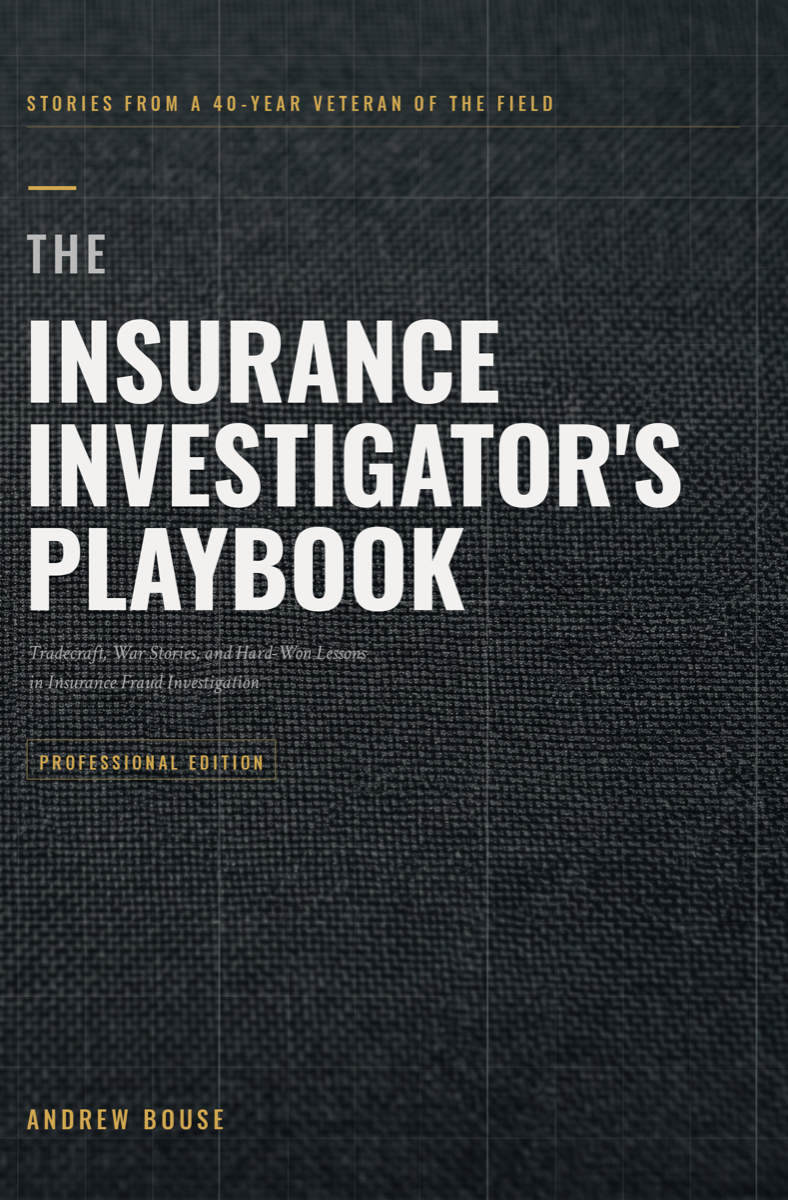
cover.png — front cover, for listings and thumbnails.
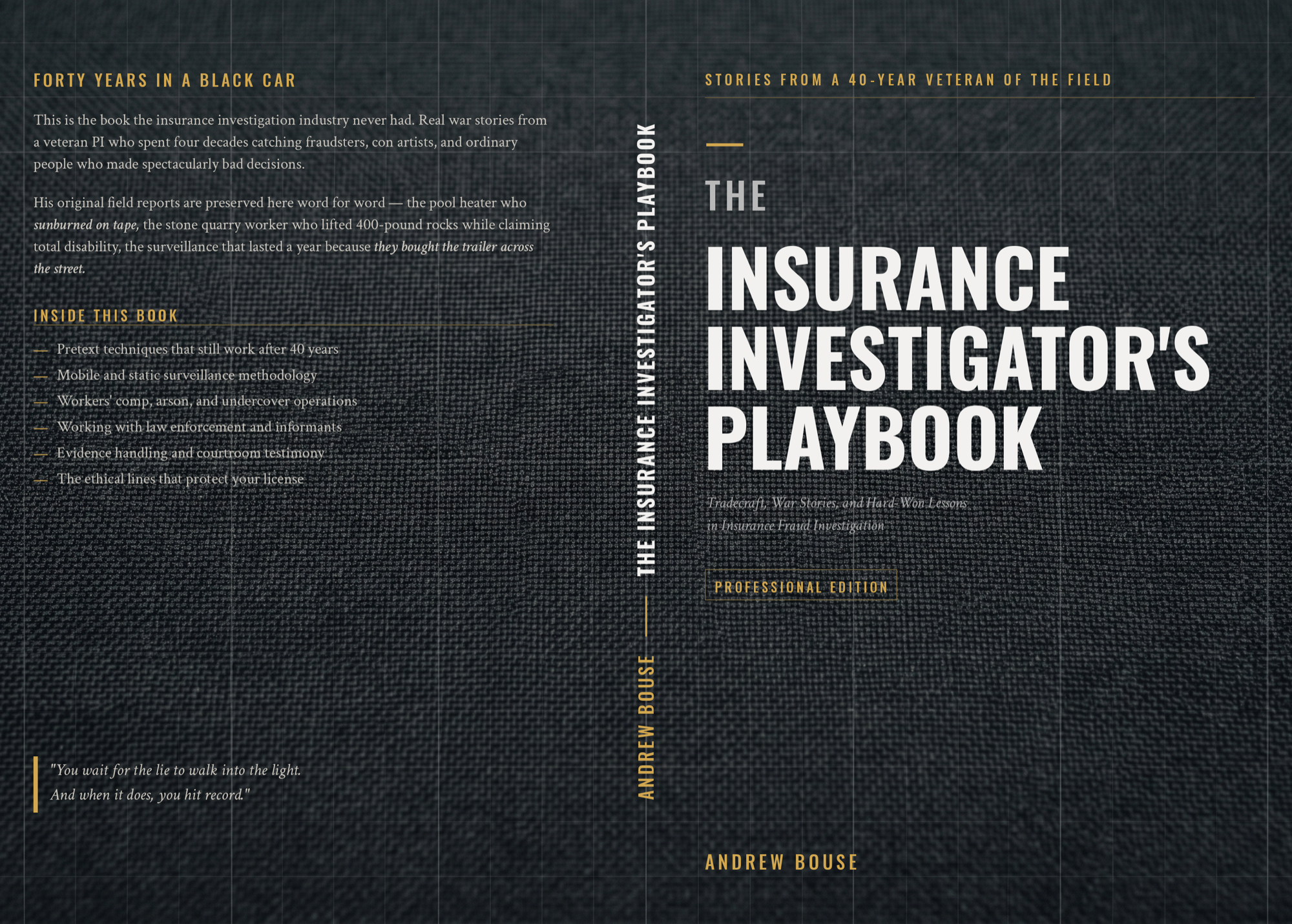
jacket-full.png — the complete wrap: back, spine, and front.
Interviews
Offered because a good question saves everyone time, not because the answers are scripted.
Because field reports are written for a carrier and a file, not for a reader — and when the file closes, the report goes in a drawer. Forty years of them almost went out with the drawer.
Mostly it looks like sitting still. The book is candid about the ratio of waiting to result, because that ratio is the job and every honest investigator knows it.
The equipment changed completely. The human behaviour did not. Pretext, patience, positioning, and documentation that survives cross-examination are the same problems they were in the 1980s.
The book devotes a chapter to it, because the boundaries protect a licence in a way the techniques never will. It also describes practices that were once ordinary and are now restricted — description is not endorsement.
New private investigators deciding whether the career is for them, and the adjusters and SIU staff who hire investigators and need to recognise good surveillance product when it lands on the desk.
Names, carriers, employers, case numbers, and identifying locations are removed or altered, and every matter is closed. Where a combination of details could identify someone, the detail was changed. The compliance page sets this out in full.
Press enquiries and review copies: theclaimsplaybook@gmail.com. Last reviewed: 12 August 2026.